
Choosing plastic molding services for a global project involves more than comparing quoted prices. A low unit cost can look attractive until tooling charges, inspection, packaging, and freight are included. A sample part helps, but it cannot reveal every production risk.
This guide to 2026’s top plastic molding services gives buyers a practical starting point. It considers process capabilities, including injection molding and other common methods, alongside material selection, mold design, production capacity, and quality controls. Ask how a supplier measures critical dimensions, documents material batches, and handles defects. A clear answer matters. So does a useful one. Look for evidence such as sample inspection reports, relevant certifications, and realistic lead-time estimates—not just polished sales claims.
Global sourcing adds details that are easy to miss. Confirm who owns the tooling, where it will be stored, and how changes are approved. Check whether the supplier can protect parts during shipment and communicate across time zones. Details matter. A supplier may excel at high-volume production yet struggle with frequent design updates or small pilot runs. No ranking fits every buyer. Treat this overview as a comparison framework, then verify each provider against your drawings, order volume, material requirements, and destination-market needs. The right choice should balance cost with dependable communication and repeatable quality.
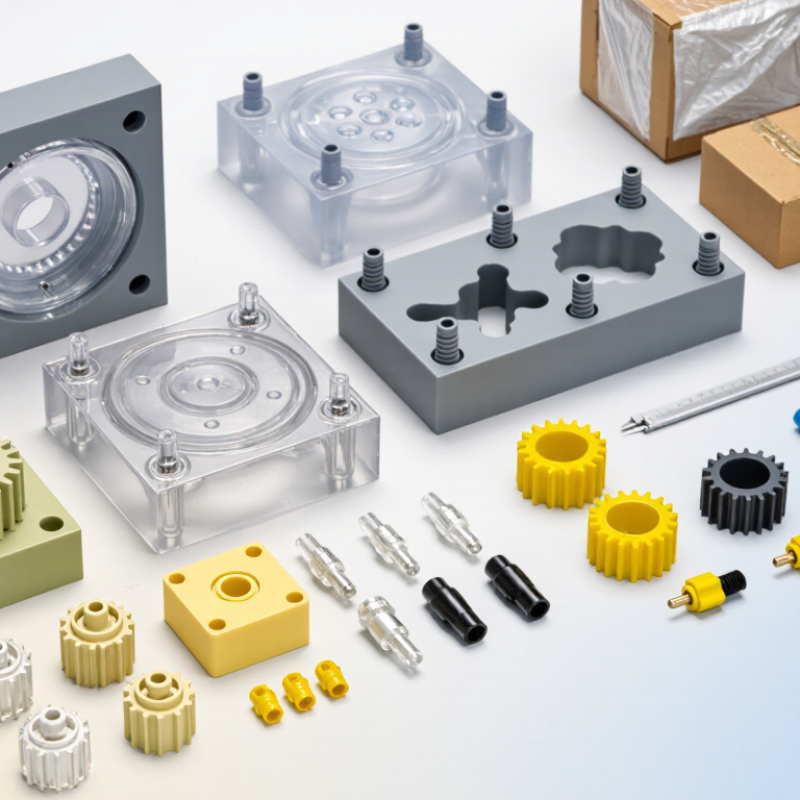
Plastic molding services turn a part drawing into repeatable components through material selection, tooling, process trials, and production checks.
Injection molding suits detailed housings and clips; blow molding forms hollow bottles and tanks; thermoforming shapes trays and interior panels. The right process depends on geometry, volume, finish, and performance—not just unit price. Fit matters.
The scale is substantial. The OECD’s Global Plastics Outlook (2022) reports that global plastics production reached 460 million tonnes in 2019, while plastic waste reached 353 million tonnes. These figures describe plastics overall, not molded parts alone, but they underline why buyers should ask about scrap handling and material traceability. For a small enclosure, even a slight shrinkage difference can misalign screw bosses or leave a visible seam.
A capable service provider reviews draft angles, wall thickness, gate location, cooling, and ejection before cutting a mold. A short trial run can reveal sink marks, warped edges, or uneven color that drawings miss. Not every risk disappears. Teams sometimes focus on the tool and underestimate inspection plans or later design changes. Buyers should clarify sample approval, tolerances, resin documentation, and change control in writing. That practical detail often matters as much as the molding machine.
PlasticsEurope’s Plastics—The Fast Facts 2023 report estimates global plastics production reached 400.3 million tonnes in 2022. That scale does not make every molding process suitable for every order. Injection molding suits repeatable, detailed parts, such as clips or housings, but tooling can make small runs costly. Extrusion continuously forms profiles, sheets, and tubing. It is efficient for consistent cross-sections, not complex standalone shapes. Blow molding makes hollow containers; wall thickness and neck finish need careful control. Thermoforming can be economical for broad trays and panels, though trimming creates scrap.
Small details matter. A deep rib, a narrow opening, or a visible weld line can change the process choice. The report’s production figure is useful context, not a measure of demand for any one process. In practice, resin, tolerances, annual volume, and finishing requirements should guide supplier comparisons. I would not choose by unit price alone; tooling, inspection, and shipping can shift the total cost.
Tips: Send a 3D model, target quantity, resin preference, and critical dimensions with your inquiry. Ask for a sample and a clear explanation of likely defects. The first design may still need revision.
A capable plastic molding provider should be judged by repeatable results, not a polished sample alone. Ask how the team controls wall thickness, shrinkage, surface finish, and dimensional variation. Request inspection records tied to actual production parts. Ask for evidence. Material selection matters too: resin grades can affect strength, appearance, cycle time, and long-term performance. A supplier should explain those trade-offs in plain language, not simply recommend the easiest material to mold.
Compare costs beyond the quoted price per part. Tooling, setup, scrap, packaging, and shipping can change the real budget. Request a written quote that separates these items and states its assumptions. Details matter. For quality checks, clarify which dimensions are critical and how often they are measured. A first-article report can help, but it cannot guarantee stable output across every production run. Ask what happens when measurements drift.
Capabilities should match the project’s size and risk. Confirm available press range, mold maintenance practices, secondary finishing, and realistic lead times. Capacity claims are worth checking against current schedules. A very low quote may reflect a genuine efficiency—or an omitted service. This is not a perfect ranking exercise: a provider with stronger documentation may cost more, while a smaller shop may offer closer communication. Weigh the evidence against your part’s tolerances, annual volume, and delivery needs.
In 2026, leading plastic molding services help global buyers turn product designs into repeatable parts. The right partner can support injection molding, insert molding, and smaller production runs. Buyers should look beyond a low unit price. Tooling costs, setup time, and shipping can change the total cost considerably.
Good suppliers ask practical questions about wall thickness, draft angles, resin choice, and expected volumes. They may use design-for-manufacturing reviews to flag sink marks or difficult ejection before steel is cut. Ask how they track dimensions and material batches. Details matter. A sample part should be checked against the drawing, not judged by appearance alone. Request clear inspection records and defined approval steps.
Global projects also depend on communication and planning. Confirm who owns the mold, how maintenance is handled, and what happens when a production issue appears. Share realistic forecasts and packaging requirements early; cartons, labels, and transit protection affect delivery quality. A capable service provider should explain its limits, too. No process eliminates every defect, and a polished presentation is not proof of consistent output. Buyers may still need independent sample checks, especially when specifications leave room for interpretation. That extra review takes time, but skipping it can cost more.
International sourcing for plastic molding is not just a unit-price exercise. A tool can be ready while resin grade, color approval, or carton dimensions remain unsettled. Small details matter. Buyers should freeze drawing revisions, define first-article checks, and confirm mold-maintenance responsibilities before production begins. A polished quotation cannot replace a clear sampling plan.
The OECD’s Global Plastics Outlook (2022) projects that plastics use could nearly triple by 2060 under current policies. That long-term forecast makes material planning and scrap control more than purchasing details. Specify the resin grade and any approved alternatives, then request batch traceability and inspection records. A schedule may look safe on paper; one late color match can still delay packing.
UNCTAD’s Review of Maritime Transport 2024 reports that maritime shipping carries over 80% of world merchandise trade by volume. The report also records 2.4% growth in maritime trade in 2023. For molded parts, confirm the production-ready date, port, sailing window, and carton dimensions early. Build time for inspection and customs clearance, and ask about an alternative route. Delivery estimates still carry uncertainty.
| Service type | Common applications | Common materials | Typical production fit | Tooling and setup | International sourcing considerations |
|---|---|---|---|---|---|
| Injection molding | Housings, closures, connectors, appliance and automotive components | PP, ABS, PE, PC, PA, POM, and selected engineering resins | Prototype through high-volume production; unit economics generally improve as volume increases | Requires a mold; cost and lead time depend on part size, complexity, cavity count, and tool requirements | Confirm mold ownership, maintenance terms, resin grade, inspection plan, and shipping responsibility |
| Insert and overmolding | Parts combining plastic with metal inserts or soft-touch features | Material combinations depend on adhesion, temperature, and mechanical requirements; examples include rigid thermoplastics with TPE | Small to high-volume runs where integrated components or multiple materials are needed | Often needs dedicated tooling and controlled insert placement or multi-shot processing | Validate material compatibility, insert sourcing, bond strength, and process controls before production approval |
| Blow molding | Bottles, containers, ducts, tanks, and other hollow parts | HDPE, LDPE, PP, PET, and PVC for suitable applications | Medium to high volumes, especially for hollow products | Mold and process setup depend on container dimensions, neck finish, wall distribution, and production method | Check leak testing, wall-thickness control, packaging efficiency, and rules for food-contact or regulated products |
| Thermoforming | Trays, panels, packaging, liners, and large covers | HIPS, PET, PETG, ABS, PP, and other sheet thermoplastics | Prototypes to medium or high volumes, depending on part design and forming method | Tooling can be simpler than an injection mold for some parts; trimming and finishing may add process steps | Review sheet specification, formed-wall variation, trim quality, and shipping volume for bulky parts |
| Compression molding | Electrical components, seals, handles, and larger or reinforced parts | Thermosets, rubber compounds, and selected composite molding compounds | Low to high volumes, depending on cycle time, tooling, and material | Tool design must account for material flow, cure or cooling, flash, and part geometry | Specify material formulation, cure requirements, critical dimensions, and any applicable electrical or safety tests |
| Rotational molding | Large hollow tanks, bins, playground products, and outdoor enclosures | Primarily polyethylene grades; other materials are used for specific process requirements | Low to medium volumes and large hollow parts where seamless construction is useful | Tooling and cycle time depend on part size, wall thickness, and design complexity | Agree on wall-thickness targets, dimensional inspection, UV or weathering needs, and freight packaging |
| Extrusion and profile molding | Pipes, tubing, seals, channels, and continuous profiles | PVC, PE, PP, TPE, and other thermoplastics suited to the profile design | Continuous production; suitable for repeat orders and cut-to-length products | Usually requires a profile die; downstream sizing, cooling, and cutting affect the finished part | Define cross-section tolerances, coil or length format, material certification, and transport limits |
Planning note: Production fit and tooling requirements are general industry guidance, not supplier quotations or guaranteed lead times. Confirm material grade, tolerances, testing, tooling terms, delivery schedule, and applicable regulations with the selected manufacturer.
All products and services provided by Innovative Plastic Molders, Inc. will meet or exceed our customer's perceived requirements and expectations. We will listen and respond to what our customers are telling us in a timely and forthright manner.

ISO 9001:2015 CERTIFIED
© Copyright 2009 – Innovative Plastic Molders, Inc.
Website by Central 8 Marketing
10451 Dog Leg Road Ste 200
Vandalia, OH 45377
Phone: 937.898.3775
Fax: 937.535.0640
Email: sale@endtheplastic.com