
BLOG

Why Choose Plastic Molding Services for Global Production?

Why Choose Plastic Molding Services for Global Production?

Global manufacturers need production methods that balance speed, precision, cost, and regulatory responsibility. Plastic molding services support this balance by converting engineered polymers into consistent parts at high volumes. PlasticsEurope reported 413.8 million tonnes of global plastics production in 2023. That scale reflects strong demand across automotive, medical, electronics, packaging, and consumer products.

Consistency matters.

A well-designed mold can produce thousands of identical housings, clips, or fluid-control components. Automated inspection systems can check dimensions, surface defects, and assembly points during production. The process also supports materials such as polypropylene, ABS, polycarbonate, and engineering-grade nylon. These options help manufacturers match strength, heat resistance, flexibility, and appearance with actual product requirements.

The numbers do not tell the whole story.

A lower quotation may conceal expensive tooling changes, weak process control, or difficult freight arrangements. Experienced suppliers review wall thickness, draft angles, shrinkage, material certification, and expected production volume before manufacturing begins. They should also provide traceable quality records and explain how regional standards affect the final product. ISO 9001-based systems can strengthen process reliability, although certification alone never guarantees excellent results.

Global production still requires careful judgment. Supply disruptions, resin price changes, and communication delays can affect delivery performance. A mold may run beautifully, then reveal warping after assembly. That is why sampling, dimensional testing, and pilot production remain essential. According to the UNEP Turning off the Tap report, better product design and circular practices could significantly reduce plastic pollution by 2040. Responsible plastic molding services should therefore support efficient material use, recyclable designs, and compliant production—not merely lower unit costs.
Why Choose Plastic Molding Services for Global Production?

What Are Plastic Molding Services?

What Are Plastic Molding Services?

Plastic molding services turn heated plastic material into precise, repeatable parts. Manufacturers use designed molds to shape products through controlled pressure, temperature, and cooling. Common methods include injection molding, blow molding, compression molding, and rotational molding. Each method suits different shapes, volumes, and performance needs.

In practical production, the process begins with product drawings and material selection. Engineers review wall thickness, corners, draft angles, and expected stresses before creating the mold. A well-designed mold can produce thousands of consistent parts, such as housings, caps, medical components, or automotive fittings. Quality teams inspect dimensions, surface texture, color, and strength during production. Small defects matter. A warped edge can affect assembly and increase waste. However, no process is perfect. Early prototypes may reveal weak ribs, uneven cooling, or unrealistic tolerances, so experienced teams revise designs before mass production. This step often saves more time than rushing into tooling.

Tips: Ask for material data, sample parts, inspection methods, and mold-maintenance plans. Confirm production volume and packaging requirements early. Request a prototype or trial run when the design is uncertain. It is also wise to review regional standards and shipping conditions before approving the final specification. Clear technical records help different production teams follow the same requirements across borders.

How Does the Plastic Molding Process Work?

Plastic molding turns carefully selected polymer into repeatable parts for global production. The process begins with a product drawing, material specification, and mold design. Engineers check wall thickness, draft angles, shrinkage, and possible weak points. Small details matter.

In injection molding, plastic pellets are dried when moisture could affect performance. The pellets enter a heated barrel and soften into a controlled melt. A screw then pushes the material through a nozzle into the mold cavity. Pressure fills narrow ribs, corners, and textured surfaces. The mold stays closed during cooling. Once the part becomes stable, ejector pins release it.

Cooling often controls the cycle time. Uneven cooling can cause warping, sink marks, or internal stress. Experienced teams measure dimensions, inspect surfaces, and compare samples against approved drawings. They may adjust temperature, pressure, holding time, or cooling channels. The first trial is rarely perfect. That is normal.

For international production, process records support consistent results across different facilities. Operators should monitor resin batches, machine settings, mold temperature, and inspection data. Packaging also needs attention, especially for parts with delicate edges or polished surfaces. A practical process is not just fast. It must remain stable when volume increases, materials change, or shipping conditions become difficult. Mistakes can still happen, so regular review is necessary.

Why Choose Plastic Molding Services for Global Production? - How Does the Plastic Molding Process Work?

The following table summarizes commonly used plastic molding methods, their typical production parameters, and the main reasons they support scalable global manufacturing. Values are indicative industry ranges and vary according to resin, part geometry, tooling design, equipment, and quality requirements.

Production Stage or Method Typical Materials Typical Operating Data Process Output Global Production Benefit Main Control Point
How the Plastic Molding Process Works
1. Product and Tooling Design CAD-based part design; mold steel or aluminum tooling Draft angles commonly begin at approximately 0.5°–2°; uniform wall design is generally preferred Validated part geometry, mold-flow review, and production-ready tooling design Digital design files can be transferred between approved production locations with consistent specifications Wall thickness, shrinkage allowance, draft, parting line, and gate location
2. Material Preparation Thermoplastics, thermosets, elastomers, or reinforced polymers Material drying may range from 2–8 hours for moisture-sensitive thermoplastics, depending on resin and drying conditions Conditioned material with controlled moisture and contamination levels Material specifications and batch records help maintain consistency across regions Moisture content, melt-flow behavior, color, additives, and lot traceability
3. Melting or Softening Polypropylene, ABS, polycarbonate, nylon, polyethylene, and other molding resins Typical melt-processing temperatures are approximately 160–350°C, depending on polymer type Material becomes sufficiently fluid or formable for cavity filling or shaping Automated temperature control supports repeatable production at different facilities Barrel or oven temperature, residence time, shear, and material degradation
4. Filling and Forming Material selected according to strength, temperature, chemical, and appearance requirements Filling time is often measured in fractions of a second to several seconds for injection molding Molten or softened plastic conforms to the mold cavity or forming tool Repeatable tooling enables the same geometry to be reproduced at high volume Injection pressure, fill speed, mold temperature, vacuum, and forming pressure
5. Cooling, Curing, or Solidification Thermoplastics, thermosets, and rubber-like materials Cooling or curing commonly takes from a few seconds to several minutes Stable molded part ready for ejection or demolding Efficient cooling reduces cycle time, energy use, and production cost Cooling-channel layout, mold temperature, cure time, warpage, and shrinkage
6. Ejection and Finishing Finished molded polymer components Secondary operations may include trimming, drilling, printing, assembly, or inspection Packaged or assembled parts that meet dimensional and visual requirements Standardized inspection plans simplify quality comparison across manufacturing locations Flash, sink marks, short shots, weld lines, burrs, color variation, and dimensions
Comparison of Common Plastic Molding Methods
Injection Molding Thermoplastics, thermosets, and liquid silicone materials Typical cycle time: 15–120 seconds; machine clamp force: approximately 10–4,000 tonnes High-volume parts with complex shapes, ribs, bosses, snap-fits, and fine surface details Highly automated, repeatable, and suitable for regional or multi-site production Fill balance, pressure, cooling efficiency, shrinkage, and mold maintenance
Blow Molding Polyethylene, polypropylene, PET, and other blow-molding polymers Typical cycle time: 10–60 seconds; common wall thickness: approximately 0.5–6 mm Hollow containers, ducts, tanks, and other enclosed or hollow products Efficient for lightweight hollow parts with reduced material consumption Parison thickness, inflation pressure, cooling, and wall distribution
Rotational Molding Polyethylene, PVC, nylon, and other rotomolding-grade polymers Typical cycle time: approximately 10–60 minutes; common wall thickness: approximately 2–12 mm Large, hollow, seamless parts with relatively even wall thickness Lower tooling cost and practical for large parts or low-to-medium production volumes Heating time, mold rotation, powder distribution, cooling, and wall uniformity
Compression Molding Thermosets, rubber compounds, composites, and some engineering polymers Typical cycle time: approximately 30 seconds–10 minutes; pressure depends on material and part area Flat, structural, electrical, and heat-resistant components Suitable for durable parts and materials that require curing under heat and pressure Charge weight, mold temperature, pressure, cure time, and fiber orientation
Thermoforming ABS, PET, PVC, polycarbonate, polystyrene, and other sheet materials Typical cycle time: approximately 10 seconds–5 minutes; sheet thickness commonly ranges from 0.5–10 mm Trays, covers, panels, liners, housings, and large thin-wall components Shorter tooling development time and economical production for large surface-area parts Sheet heating, vacuum or pressure level, draw ratio, cooling, and trimming
Insert or Overmolding Plastic combined with metal inserts, textiles, elastomers, or another polymer Additional molding cycle commonly ranges from 20–180 seconds, depending on part size and automation Integrated components with improved grip, sealing, insulation, or mechanical fastening Can reduce assembly steps, labor content, and the number of separate components Insert positioning, bonding, shrinkage differences, sealing, and automated loading
Why Plastic Molding Supports Global Production
Production Scalability Tool-based manufacturing with interchangeable production equipment Injection molding can produce cycle volumes ranging from hundreds to many thousands of parts per day, depending on cavity count and cycle time Repeatable output at low, medium, or high production volumes Manufacturers can match equipment capacity and cavity count to regional demand Capacity planning, uptime, cavity balance, and preventive maintenance
Dimensional Repeatability Engineering-grade thermoplastics and reinforced polymers Typical molded-part tolerances may range from approximately ±0.05 to ±0.50 mm, depending on size, material, and geometry Consistent dimensions suitable for assembly and functional testing Common drawings, control plans, and inspection methods support cross-border quality management Material shrinkage, mold temperature, process capability, and measurement method
Material Efficiency Recyclable and non-recyclable polymer systems, including regrind where permitted Runner and sprue waste can be reduced through hot-runner systems or optimized gating; allowable regrind depends on material and specification Lower material waste and improved part-cost control Material standards can be documented and audited across multiple supply locations Regrind percentage, contamination, color consistency, and recycled-content requirements
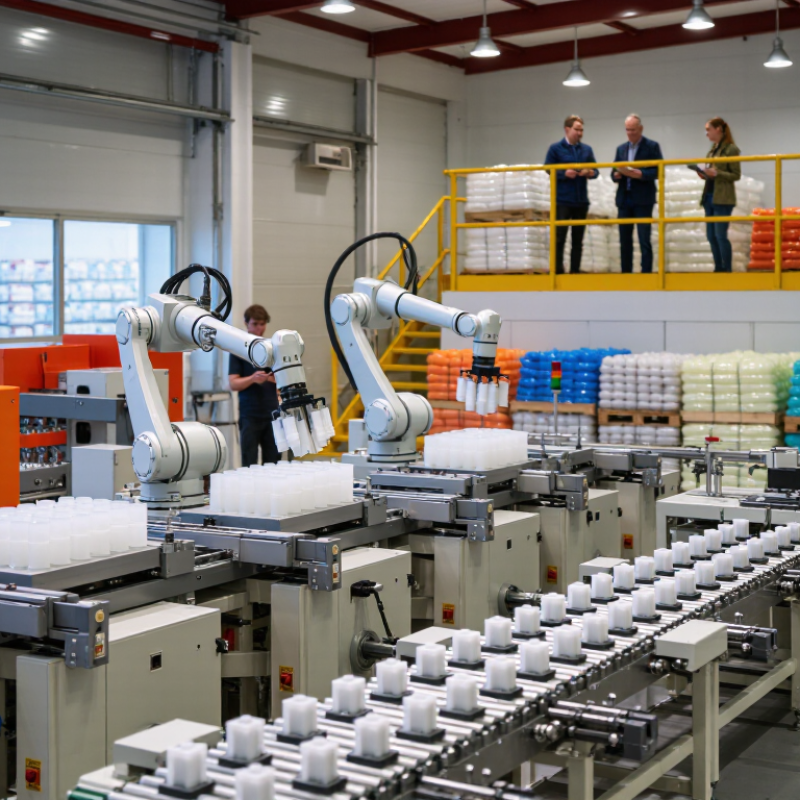
Automation Potential Parts compatible with robotic handling, conveyors, vision inspection, and automated assembly Automated operations can combine part removal, trimming, inspection, packaging, and labeling within one production cell Reduced manual handling and more consistent production records Automation helps address labor variation and supports standardized global output Robot repeatability, sensor calibration, error detection, and data logging
Quality and Traceability Controlled resin batches and documented process parameters Typical controls include first-article inspection, sampling inspection, dimensional checks, visual inspection, and batch records Documented evidence that parts meet agreed specifications Traceability improves supplier qualification, corrective actions, and regulatory readiness Inspection frequency, calibration, nonconformance handling, and change control

Note: The numerical ranges shown are typical planning values rather than guaranteed specifications. Final results depend on part design, polymer grade, mold construction, machine capability, production environment, and applicable quality standards.

Which Benefits Support Global Plastic Production?

Why Choose Plastic Molding Services for Global Production?

Which Benefits Support Global Plastic Production?

Plastic molding services give manufacturers a repeatable way to produce parts across regions. A validated mold can create thousands of housings, caps, or technical components with consistent dimensions. This consistency helps plants in different countries follow the same drawings and inspection criteria. It also reduces adjustment time during production transfers.

Global programs benefit from material expertise. Engineers can match resin selection to heat, impact, moisture, and chemical exposure. They can assess shrinkage before tooling begins. That step matters when a two-millimeter variation affects assembly. Digital mold-flow studies, trial runs, and measurement reports add practical evidence. Still, simulations are not perfect. Real resin batches and local conditions can behave differently.

Scalable molding supports changing demand without redesigning every part. Automated handling can improve output, while documented process controls strengthen traceability. Disciplined quality systems can provide inspection records, sample approvals, and corrective-action data. These records help purchasing and engineering teams communicate across time zones. Regional packaging and shipping plans may reduce damage and delays. Yet global production is not automatically efficient. Tool maintenance, backup capacity, and clear ownership must be planned early. A cheaper quote can become expensive after repeated adjustments.

Why Choose Plastic Molding Services for Global Production?

Regional plastic production capacity highlights why scalable molding services, standardized tooling, and distributed manufacturing are important for global supply chains.

Share of global plastics production by region, 2019. Source: OECD, Global Plastics Outlook.

How Do Plastic Molding Services Ensure Quality and Consistency?

Plastic molding services protect quality through controlled, repeatable processes rather than visual inspection alone. The ISO Survey 2022 recorded more than 1.2 million ISO 9001 certificates worldwide, showing how widely documented quality systems support manufacturing consistency. In practice, trained engineers review resin certificates, drying conditions, mold temperature, injection pressure, and cooling time before production begins. Each parameter affects the final part. A small moisture increase can create bubbles, weak weld lines, or unwanted shrinkage.

Reliable suppliers also use first-article inspections, coordinate-measuring machines, and statistical process control. Critical dimensions are checked against approved drawings, while production data reveals drift before defective parts accumulate. The PlasticsEurope Plastics—The Facts 2023 report estimated global plastics production at 400.3 million tonnes in 2022, highlighting the scale that demands stable, measurable production methods. Material traceability matters at this volume. Lot numbers, machine settings, operator records, and inspection results should remain connected.

No process is flawless. A clean report can still miss a hidden mold-wear problem. That is why experienced teams combine automated measurements with hands-on review, especially during tool changes or new resin trials. Capability studies, such as Cpk analysis, can expose whether a process is truly centered or merely passing occasional inspections. Consistency comes from repetition, evidence, and the willingness to question results that look unusually perfect.

What Factors Should Businesses Consider When Choosing a Provider?

Choosing plastic molding services for global production requires more than comparing unit prices. A capable provider should explain tooling design, resin selection, cycle times, and inspection methods clearly. Ask for recent production examples with similar part sizes, tolerances, and surface finishes. A sample part can reveal flash, sink marks, warping, and inconsistent color. These details matter when thousands of components move between factories, warehouses, and assembly lines. Look for documented quality controls, trained technicians, calibrated equipment, and traceable records. Experience should be visible in evidence, not promises.

Businesses should also examine capacity and production continuity. Can the provider support a pilot run, then increase output without changing critical processes? Review mold maintenance plans, backup equipment, material sourcing, packaging standards, and shipping coordination. For international production, confirm how the team handles specifications, product documentation, and destination-market requirements. Clear communication is essential when time zones, languages, or engineering changes create friction. A provider may offer attractive pricing but lack dependable escalation procedures. That weakness often appears only after a delayed shipment. It deserves attention earlier.

Tips: Request a written quotation covering tooling ownership, tolerances, lead times, payment stages, and inspection criteria. Order a small trial batch before approving full production. Ask who investigates defects and how corrective actions are recorded. Visit the facility when practical, or arrange a live video audit. Review references carefully, but do not treat them as proof. No supplier is flawless. A thoughtful risk review may be more valuable than a polished presentation. Keep communication records and approve every engineering change in writing.

Go to Top