

Choosing the best China Dynamic Seal manufacturer requires more than comparing prices or browsing polished websites. It demands evidence, technical understanding, and careful supplier evaluation. A reliable manufacturer should demonstrate experience with hydraulic seals, pneumatic seals, rotary seals, and customized sealing systems. Factory capacity matters. So does process control.
Look for clear material specifications, such as polyurethane, NBR, FKM, or PTFE. Ask how compounds are tested under pressure, heat, friction, and chemical exposure. A professional supplier should provide dimensional reports, batch records, and practical application guidance. Photos of clean production lines can help, but documents and samples matter more. Real proof matters.
The strongest manufacturers usually combine mold development, precision machining, laboratory testing, and stable quality management. They should explain tolerances without hiding behind vague claims. Their engineers should understand leakage risks, shaft surface finish, installation damage, and changing operating temperatures. Communication also reveals expertise. Slow answers may signal weak support, although this is not always true.
No supplier is perfect. A factory may have excellent equipment but limited export experience. Another may offer fast delivery but weaker customization support. That is why this evaluation must remain balanced and based on verifiable information. Product samples, audit discussions, and small trial orders can expose problems early. Practical experience often reveals details that catalogs omit.
This guide examines China’s leading Dynamic Seal manufacturers through product quality, engineering capability, certifications, service reliability, and application experience. It also considers whether each supplier can support long-term cooperation, not merely complete one order. The best choice depends on your equipment, working conditions, and risk tolerance. Price matters, but failure costs more.
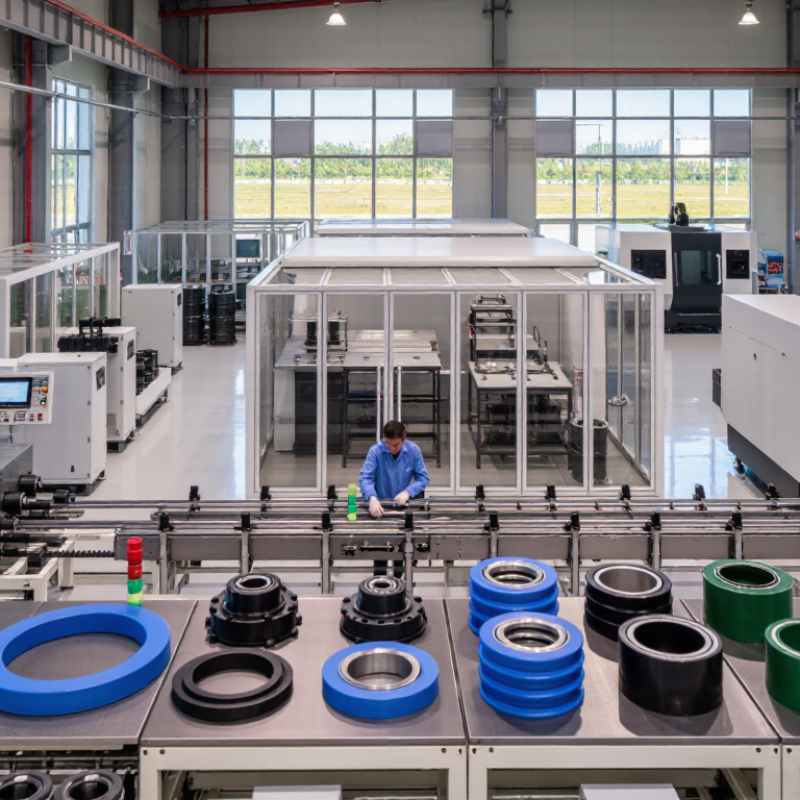
A capable China dynamic seal manufacturer should explain motion before quoting material or price. Dynamic seals face three common motions: reciprocating rods, rotary shafts, and oscillating joints. Each creates a different wear pattern. Reciprocating service can pump contamination past the lip. Rotary service adds heat from sliding speed. Oscillation may reverse lubrication repeatedly.
The 2024 Seals Market report from MarketsandMarkets estimates the global seals market at about US$14 billion, with mid-single-digit growth expected. That growth does not prove quality.
Pressure class needs a test boundary, not a brochure number. Specify pressure, speed, temperature, fluid, shaft finish, clearance, and duty cycle. ISO 3601 covers O-ring dimensions and tolerances, while ISO 19973-1 defines reliability-testing principles for pneumatic components. Neither standard makes every seal suitable for every pressure class.
A practical supplier should provide leakage data at the intended pressure, not only a maximum rating. Ask for batch traceability and material certificates. Small gaps matter.
A 10⁶-cycle target is useful for pumps, cylinders, and actuators, but it is not a universal guarantee. Test rigs should record leakage, friction, temperature, and wear at set intervals.
ASTM D1414 provides laboratory methods for rubber O-ring testing, yet field loads can be less tidy. Dust, misalignment, and dry starts change results. I would request the failed samples, too. That detail is often missing.
A strong manufacturer reports confidence limits, fixture conditions, and the number of tested parts. Without those details, “one million cycles” is only a hopeful headline.
Choosing a Chinese dynamic seal manufacturer requires more than comparing prices. ISO 3601 helps verify O-ring dimensions, tolerances, and identification requirements. For a moving seal, these details affect friction, extrusion risk, and leakage. A supplier should provide inspection records for every production batch, not only a general certificate.
ASTM D2000 classifies rubber materials by performance, temperature resistance, and chemical exposure. It does not replace application testing. Ask for hardness, tensile strength, elongation, and compression set results. For hydraulic cylinders, request evidence from reciprocating tests using the actual fluid and temperature range. Small differences matter. A seal tested at room temperature may behave differently at 120°C.
GB/T 3452.1 is important when selecting O-ring sizes and tolerances for the Chinese market. Reliable manufacturers should control mold dimensions, flash, surface defects, and material traceability. A practical audit should include sample measurements with calibrated tools, storage checks, and a review of rejected parts. Certificates need context. They can be accurate yet outdated. I have seen projects focus heavily on ISO paperwork while ignoring groove design and installation damage. That approach is incomplete. The better supplier explains limitations, recommends suitable compounds, and accepts independent testing when performance remains uncertain.
What Is the Best China Dynamic Seal Manufacturer?
Material choice matters more than factory location when temperatures move from −40°C to 260°C. Industry reference tables based on ASTM D1418 and ISO 1629 typically place NBR near −40°C to 100°C. NBR offers strong abrasion resistance and low cost, but heat aging becomes visible quickly. EPDM usually performs from about −50°C to 150°C and handles hot water, steam, and weathering well. It is unsuitable for many petroleum oils.
FKM commonly covers approximately −20°C to 200°C, with selected grades reaching 230°C intermittently. Its low-temperature flexibility is limited. That weakness is often missed. PTFE remains the broadest option, with common service guidance near −60°C to 260°C. However, high temperature can increase creep, leakage, and stick-slip during reciprocating movement.
Data summarized in the 2023 edition of the Rubber Handbook shows that compression set and tensile retention change sharply after prolonged thermal exposure. Laboratory values are not operating guarantees. ISO 23936-2 also stresses qualification under actual pressure, fluid, and temperature conditions. In practical testing, a seal cycling at 180°C in hydraulic oil may behave differently from one exposed to 180°C steam. A competent manufacturer should provide batch traceability, hardness data, compression-set results, and dynamic test records. Frankly, temperature charts alone are insufficient. Many selections still overlook speed, shaft finish, and pressure spikes.
Choosing the best China dynamic seal manufacturer starts with evidence, not attractive samples. In supplier audits, I check ISO 9001 certification, scope, expiry date, and issuing body. ISO’s 2023 Survey recorded more than 1.2 million ISO 9001 certificates worldwide. That figure shows quality certification is common, but it does not prove sealing performance. Ask for process maps, inspection plans, nonconformance records, and corrective-action results.
For automotive applications, IATF 16949 is more relevant. The IATF certification database reported more than 75,000 certified sites globally in recent years. A capable supplier should connect this system with PPAP documentation. Request material certificates, dimensional reports, capability studies, control plans, and signed approval records. Check whether the PPAP matches the exact seal compound and tooling. Small differences matter. A seal may pass laboratory testing but fail after heat, pressure, or shaft movement.
Traceability should reach the production lot, operator, mold, material batch, and inspection equipment. Scan a sample record and confirm that it can be retrieved within minutes. I also compare certificate details with the supplier’s actual factory address. This simple step is often missed. Some suppliers present excellent documents but weak shop-floor discipline. That is a warning. Keep retention periods, change-control rules, and requalification requirements in writing. Independent testing can add confidence, although it increases cost and time. A certificate file is useful, not conclusive. Supplier evaluation still needs factory visits, production samples, and honest review of failure data.
What Is the Best China Dynamic Seal Manufacturer?
A reliable dynamic seal manufacturer should prove performance under controlled, repeatable conditions. Leakage testing begins with a defined pressure, temperature, shaft speed, and test medium. Engineers should record leakage at startup, steady operation, and shutdown. A seal that passes only at room temperature may fail beside a hot pump.
Friction and wear data reveal more than a simple pass-or-fail result. Measure starting torque, running torque, seal temperature, and mass loss after testing. Inspect the sealing lip under magnification. Small cracks can appear before visible leakage. In a 1,000-hour durability test, the test rig should log pressure and speed continuously. Samples should be checked at regular intervals, such as 100, 500, and 1,000 hours. Independent verification adds credibility. Still, test data can mislead when conditions differ from field use. That limitation deserves clear disclosure.
Tips: Ask for raw test records, not only charts. Confirm the material batch, shaft finish, lubricant, and test temperature. Request photographs before and after testing. One practical improvement is using duplicate samples, although this increases time and cost. Our own early comparisons sometimes relied on too few samples. The results looked precise, but they were not fully representative. A stronger supplier welcomes repeated testing and explains abnormal results instead of hiding them.
All products and services provided by Innovative Plastic Molders, Inc. will meet or exceed our customer's perceived requirements and expectations. We will listen and respond to what our customers are telling us in a timely and forthright manner.

ISO 9001:2015 CERTIFIED
© Copyright 2009 – Innovative Plastic Molders, Inc.
Website by Central 8 Marketing
10451 Dog Leg Road Ste 200
Vandalia, OH 45377
Phone: 937.898.3775
Fax: 937.535.0640
Email: sale@endtheplastic.com

