

Choosing the right storage system can shape warehouse safety, picking speed, and long-term operating costs. This guide explores the Top 10 Types of Boltless Rivet Racks for Global Buyers, focusing on practical differences rather than attractive catalog images. Each rack type uses a boltless connection method, allowing shelves to be adjusted with limited tools. That matters when inventory changes every season.
Real warehouses rarely look perfect. Floors may slope slightly. Boxes may vary in weight. Workers may need to reposition shelves during busy periods. The best Boltless Rivet Rack should match these conditions, not simply offer the highest stated load capacity. This article examines shelving for light-duty storage, heavy-duty pallets, tires, long materials, corner spaces, and mobile applications. It also considers frame strength, deck materials, corrosion resistance, assembly time, and replacement availability.
Details matter.
A reliable evaluation should begin with verified dimensions, tested load ratings, and clear installation guidance. Global buyers should also confirm packaging quality, export experience, after-sales support, and compatibility with local warehouse practices. Product names can be confusing, and supplier descriptions are not always consistent. Some comparisons will remain judgment calls because warehouse priorities differ. A retail stockroom may value quick access, while a factory may need deeper shelves and greater stability. The following overview offers a professional starting point, while encouraging buyers to measure their actual space, review safety requirements, and request technical documentation before placing an order.
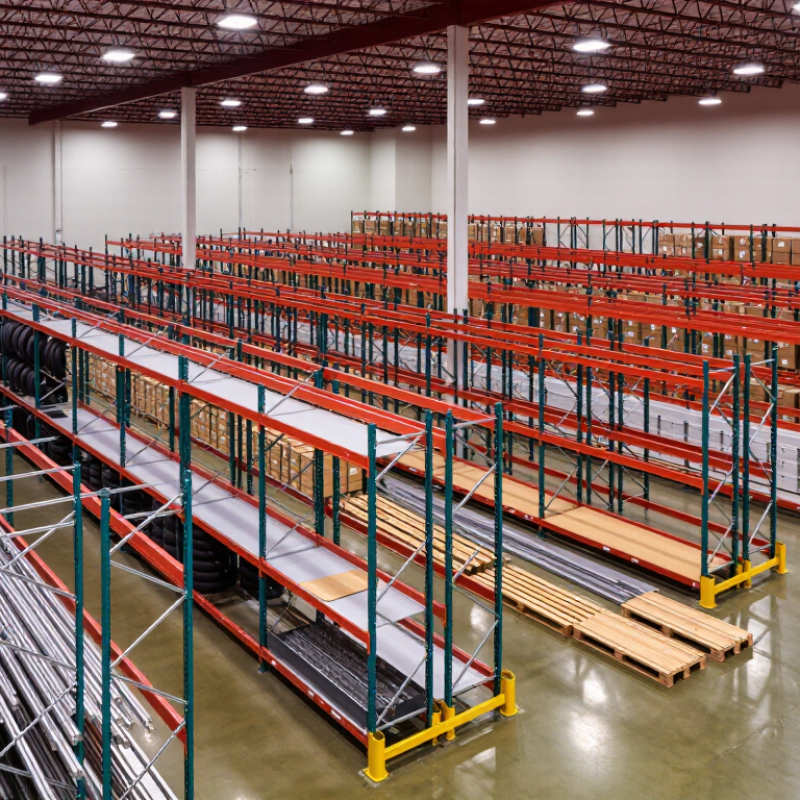
Boltless rivet racks use punched uprights, horizontal beams, and decking panels. Rivets lock into the slots without nuts or bolts. Common types include standard, wide-span, heavy-duty, corner, mobile, back-to-back, tire, carton-flow, low-profile, and long-span designs. Each configuration changes its load path and usable volume.
A rack carries weight from the deck into the beams, then through the riveted connections and uprights. The floor receives the final load. Uneven cartons can twist beams, even when the total weight stays below the advertised capacity. ANSI MH16.1-2023 provides design guidance for steel storage racks, while EN 15635 emphasizes inspection and safe operation. The U.S. Bureau of Labor Statistics reported 2.6 million nonfatal workplace injuries and illnesses in private industry during 2023. Storage handling remains a practical safety concern. I have seen small assembly errors create large alignment problems. The manual is not decoration.
Tips: Confirm the stated load per level. Place dense goods low. Distribute cartons evenly. Inspect bent uprights, loose rivets, and damaged decking. Use a rubber mallet during assembly. Do not climb the rack. Anchor units where impact or vibration is possible. Recheck capacity after adding shelves or changing spans. A longer beam is not automatically stronger. Capacity depends on steel thickness, connection quality, spacing, and floor conditions.
For global buyers, boltless rivet racks are more than quick-assembly shelving. They support cartons, spare parts, tools, and industrial components. The main formats include standard heavy-duty, double-rivet, extra-deep, long-span, wire-deck, steel-deck, wood-deck, bin, tire, and multi-level rack systems. Capacity depends on beam length, frame height, deck material, and load distribution.
The 2024 MHI Annual Industry Report surveyed more than 1,000 supply-chain professionals. It identified labor availability and operational efficiency as continuing warehouse concerns. Boltless designs can reduce assembly time, but workers still need controlled lifting practices.
ANSI MH16.1 and EN 15635 provide useful benchmarks for rack design, inspection, and safe operation. Buyers should request test reports, maximum bay loads, deflection limits, and clear installation instructions. Check local seismic and wind requirements too.
Steel decks suit heavier components and frequent handling. Wire decks improve visibility and airflow. Wood decks usually reduce initial cost. Extra-deep and long-span formats increase volume, but they can encourage unsafe overloading.
I would not accept a capacity label without checking the actual frame, rivet connection, and shelf spacing. A rack may look rigid while its weakest deck carries the real risk. Field conditions are rarely perfect; uneven floors, mixed cartons, and future load changes deserve honest review.
Boltless rivet racks suit warehouses that need fast assembly and flexible storage. The main designs include long-span shelving, wide-span shelving, bulk-storage racks, bin shelving, tire racks, carton-flow units, archive racks, multi-tier racks, vertical dividers, and heavy-duty rivet frames.
Long-span racks work well for cartons, tools, and medium-sized components. Their deeper shelves reduce wasted aisle space.
Wide-span designs provide broader decks for furniture, panels, and irregular loads.
Bulk-storage rivet racks handle dense inventory with fewer shelf levels. They are useful for boxed goods, seasonal stock, and reserve materials.
A practical layout may use 900-millimeter-deep shelves, reinforced particle board, and clearly marked load labels.
The choice depends on carton weight, access frequency, ceiling height, and floor condition. Bigger is not always better. That assumption is often wrong.
The 2024 MHI Annual Industry Report indicates that inventory and network optimization technology could reach 87% adoption within five years, compared with about 38% currently. This suggests stronger pressure for adaptable storage systems.
Research from Grand View Research also reports continuing growth in warehouse racking demand, driven by e-commerce and higher inventory volumes. These figures support modular rack planning, but they do not replace site measurements.
I would verify beam deflection, upright spacing, and floor loading before purchase. Human judgment still matters. A slightly smaller long-span rack may outperform a wide-span system when aisles are narrow and workers need safer, faster access.
Boltless rivet racks suit warehouses that need fast assembly and flexible storage. The ten useful configurations include standard, mobile, corner, low-profile, wide-span, back-to-back, multi-tier, bin-ready, heavy-duty, and cantilever-style racks. Mobile racks add casters, saving aisle space during seasonal peaks. Corner racks turn awkward L-shaped areas into usable storage. Multi-tier designs create vertical picking levels without permanent construction.
In field planning, I check load labels, beam seating, floor condition, and forklift clearance before selecting a layout. Wide-span racks fit cartons and bulky components. Bin-ready frames support small parts, while cantilever-style rivet racks handle long materials. MHI’s 2024 Annual Industry Report surveyed more than 1,200 supply-chain professionals and reported continued investment in warehouse technology and efficiency. That finding supports adaptable rack systems, but it does not make every mobile rack suitable for heavy loads. Stability can be overlooked.
Tips: Measure the tallest package first. Leave clear access around corners. Confirm each level’s capacity, not only the total frame rating. Use diagonal bracing where movement or vibration is possible. A simple trial bay often exposes poor reach distances before full installation. I once underestimated handle clearance; the rack worked, but daily picking felt awkward. That small mistake deserved more attention. Safety guidance and local engineering requirements should still govern the final configuration.
Global buyers often compare ten rack types: light-duty, medium-duty, heavy-duty, long-span, mobile, narrow-aisle, corner, bin, archive, and tire racks. Capacity should match real warehouse use, not only catalog figures. Measure shelf width, depth, beam span, and load per level. A 500-kilogram shelf may hold less when items are unevenly placed.
Check the material carefully. Powder-coated steel suits dry indoor storage, while galvanized surfaces offer better protection in humid areas. Rivet connections should fit tightly, with level beams and stable posts. During site inspections, I look for bent uprights, missing braces, sharp edges, and overloaded shelves. Small defects can become serious safety problems.
Safety comparisons need clear evidence. Ask for tested load ratings, assembly instructions, warning labels, and inspection guidance. Standards differ between markets, so buyers should verify applicable workplace and structural requirements locally. Do not assume one certificate covers every country. A rack may pass a laboratory test yet fail after poor installation. That happens.
Some buyers focus too heavily on maximum capacity. Real performance also depends on floor strength, forklift movement, temperature, and loading habits. Adjustable shelves improve flexibility, but frequent changes can loosen components if workers rush.
A practical comparison includes delivery quality, replacement parts, and training support. The cheapest option is not always economical. A perfect comparison is rare. Recheck the numbers before ordering.
All products and services provided by Innovative Plastic Molders, Inc. will meet or exceed our customer's perceived requirements and expectations. We will listen and respond to what our customers are telling us in a timely and forthright manner.

ISO 9001:2015 CERTIFIED
© Copyright 2009 – Innovative Plastic Molders, Inc.
Website by Central 8 Marketing
10451 Dog Leg Road Ste 200
Vandalia, OH 45377
Phone: 937.898.3775
Fax: 937.535.0640
Email: sale@endtheplastic.com

