What Is Laser Film and What Is It Used For?
Laser Film is a specialized film material designed to interact with laser light or support laser-based imaging, marking, and cutting. The term does not describe one universal product. It may refer to laser-printable transparency film, laser-marking film, holographic film, or a coated polymer sheet for optical applications. That distinction matters.
A laser printer can create sharp technical drawings on suitable film, while an engraving system may alter a film’s surface through controlled heat. In packaging, Laser Film can add reflective patterns, security details, or decorative effects. In engineering, it may support alignment targets, circuit artwork, or prototype labels. Some films are clear and glossy. Others appear matte, metallic, or slightly textured under direct light.
Performance depends on the film’s coating, thickness, heat resistance, and compatibility with the laser wavelength. A material that works well in a low-temperature printer may deform inside a high-power marking system. It can curl, discolor, or release unwanted fumes. Small details matter.
Reliable selection should begin with the manufacturer’s technical data sheet. Check the recommended printer, laser type, power range, surface treatment, and operating temperature. A controlled sample test is also wise. Real results may differ from the brochure. Even experienced users can overlook humidity, storage conditions, or uneven focusing. This article examines what Laser Film means, how it works, and where it is commonly used. It also considers practical limitations, safety expectations, and the questions buyers should ask before choosing a product.
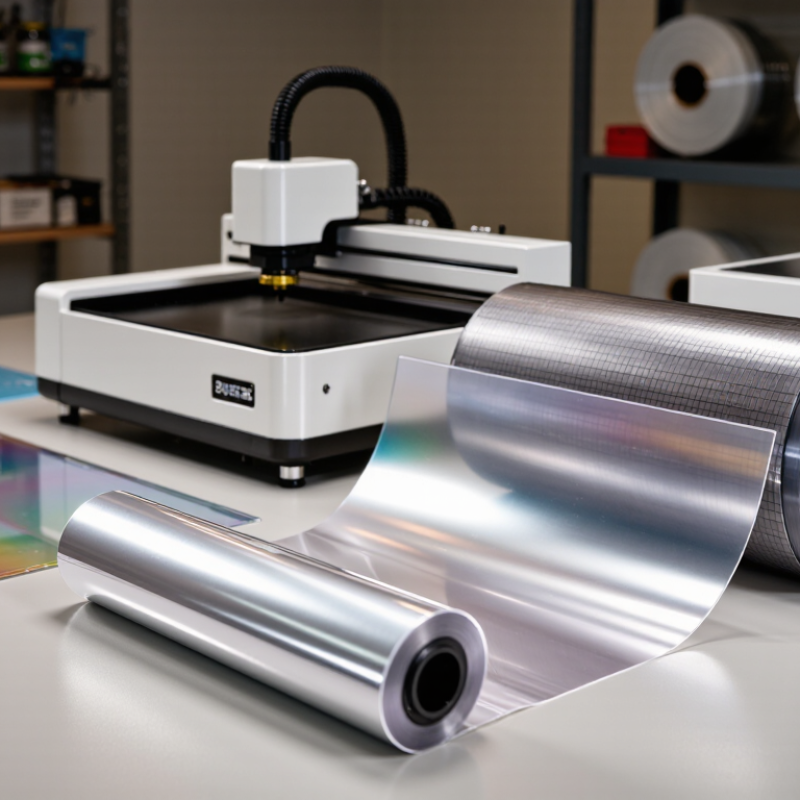
Laser Film Defined: PET Media for 355, 532, and 1,064 nm Lasers
What Is Laser Film and What Is It Used For?
Laser film is a specialized PET-based media for recording, displaying, or transferring laser-generated information. Its polyester base provides dimensional stability, a smooth surface, and controlled optical behavior. The right film depends on wavelength, exposure energy, resolution, and the intended result. Film designed for 355 nm ultraviolet lasers may not perform well with 1,064 nm infrared systems. Wavelength matters.
At 355 nm, laser film can support fine marking, imaging, and technical pattern production. Ultraviolet energy may create precise features, but it can also stress coatings and surfaces. Green 532 nm lasers commonly support visible imaging and alignment-related work. The film should deliver clear contrast without excessive flare. For 1,064 nm lasers, infrared-sensitive media are necessary because the beam cannot be seen. This creates a practical hazard. Use calibrated settings and suitable laser safety controls.
In practical workflows, PET laser film can support stencil preparation, phototool production, inspection records, and transparent overlays. Clean handling is essential. Fingerprints scatter light. Dust creates false defects. Store sheets flat, away from heat and humidity, then test a small area before full production. Nominal wavelength matching is only a starting point. Pulse duration, power density, focus, and coating chemistry can change the outcome. A film may look sharp at 532 nm yet show weak density at 355 nm. Check line edges, dimensional stability, adhesion, and long-term readability under real operating conditions.
Laser Film Construction: 50–250 μm PET with Functional Coatings
What Is Laser Film and What Is It Used For?
Laser Film Construction: 50–250 μm PET with Functional Coatings
Laser film is a precision-engineered PET film designed for laser printing, marking, imaging, and technical overlays. Its PET base usually measures between 50 and 250 μm thick. Thinner grades bend easily around curved surfaces. Thicker grades feel more rigid and resist handling damage. This small difference can affect feeding, cutting, and final registration.
The surface carries functional coatings rather than relying on bare PET. These layers may improve toner adhesion, ink reception, static control, heat resistance, or scratch protection. During production, coating uniformity matters greatly. A coating that varies across the roll can create uneven color, weak adhesion, or visible streaks. In practical testing, I would inspect both the printed surface and the unprinted edges. Defects often appear there first.
Laser film supports durable labels, control panels, equipment markings, document overlays, and diagnostic graphics. The correct thickness depends on the application, printer path, and required flexibility. A 50 μm film may suit lightweight overlays, while a 250 μm grade can provide a more substantial panel feel. However, thicker does not always mean better. Excess rigidity can cause feeding problems or poor conformity on curved parts. Humidity, heat, and cleaning chemicals also influence performance. A coating that looks effective on paper may disappoint after repeated wiping. Small trials remain essential.
How Laser Imaging Works: Contrast, Resolution, and 1,200 dpi Output
Laser film is a photosensitive recording medium for medical images, often used when a physical copy is required. Laser imaging exposes the film with controlled light pulses, creating different shades of black, gray, and white. The result depends on exposure accuracy, film chemistry, and processing conditions.
Contrast separates tissues with slightly different densities. Resolution shows how closely small structures can appear without merging. At 1,200 dpi, a laser imager places about 47 addressable dots per millimetre. That sounds extremely precise. However, dot pitch is not the same as visible diagnostic detail. Film grain, optical focus, and image compression can reduce effective resolution. This is where specifications can mislead.
The American Association of Physicists in Medicine, in Report No. 93, emphasizes sensitometric checks, density consistency, and image-quality testing for diagnostic imaging systems. DICOM PS3.3 also supports standardized image presentation and grayscale interpretation across clinical workflows. Technicians should inspect low-contrast details, edge sharpness, and uniformity, not only the 1,200 dpi label. A 2023 industry analysis by Grand View Research identified continued demand for diagnostic imaging equipment, especially in hospitals and outpatient facilities. Yet printed images still need human review under controlled lighting. Small workflow errors matter. A slightly weak contrast curve may hide a faint boundary, even when the output appears technically sharp.
Choosing Laser Film: Wavelength, Heat Resistance, and ISO 18916 Tests
Laser film is a transparent imaging material used for medical records, technical drawings, phototools, and overhead projection. Its performance depends on more than clarity. The film must respond to the printer’s laser wavelength. Many imaging systems operate near 635–670 nm or 780–830 nm, but the exact range varies by equipment. Confirm the printer specification before purchasing. A mismatch can produce weak density, uneven lines, or a gray background.
Heat resistance matters during printing and storage. Laser fusers commonly expose media to roughly 160–220°C for a short time, although temperature and pressure vary by machine. Choose film with a documented fuser rating, dimensional stability, and low curl. ASTM and ISO imaging-material guidance supports testing density, dimensional change, and surface defects under controlled conditions. ISO 18916 is different. It evaluates photographic activity from storage and enclosure materials, including stain and image-density change; it is not a universal fuser-temperature test. That distinction is easy to miss.
Professional digital-printing market reports from Smithers and IDC continue to identify short-run, variable-data output as important application areas. However, market growth does not guarantee compatibility. Request spectral sensitivity data, test a small batch, and inspect a 1 mm line under transmitted light. A neat specification can still mislead. Real equipment trials remain necessary.