

Choosing the best Parchment Paper for global sourcing requires more than comparing prices per carton. Buyers must examine coating, basis weight, roll dimensions, release performance, and food-contact documentation. A baker needs paper that releases cleanly from butter-rich pastries. A factory needs stable winding, consistent thickness, and fewer machine stoppages. Small differences become expensive at container scale.
Industry reports provide useful direction, although their estimates do not always match. Smithers’ market analysis identifies food packaging and baking applications as important growth areas for specialty paper. Grand View Research also forecasts continued expansion in the global parchment paper market, supported by convenience baking and demand for fiber-based packaging. These reports suggest opportunity, not certainty. Regional consumption, freight costs, and certification requirements can change the commercial picture quickly.
Packaging consultant Robert Lilienfeld offers a practical principle: “Packaging is a system, not an object.” That idea matters when evaluating overseas suppliers. A low-cost Parchment Paper may fail during high-speed packing, create excess waste, or require thicker sheets. The cheaper option may not be cheaper. Ask for production samples, migration test results, coating specifications, and recent quality records. Check whether the supplier can maintain the same performance across lots. Look closely at curled edges and uneven silicone coverage. Those details often reveal process weakness.
No sourcing score is perfect. This framework still has blind spots, especially when supplier data is incomplete. Yet disciplined testing, transparent documentation, and realistic total-cost analysis create a more reliable buying decision. Global sourcing should reward measurable performance, not attractive claims alone.
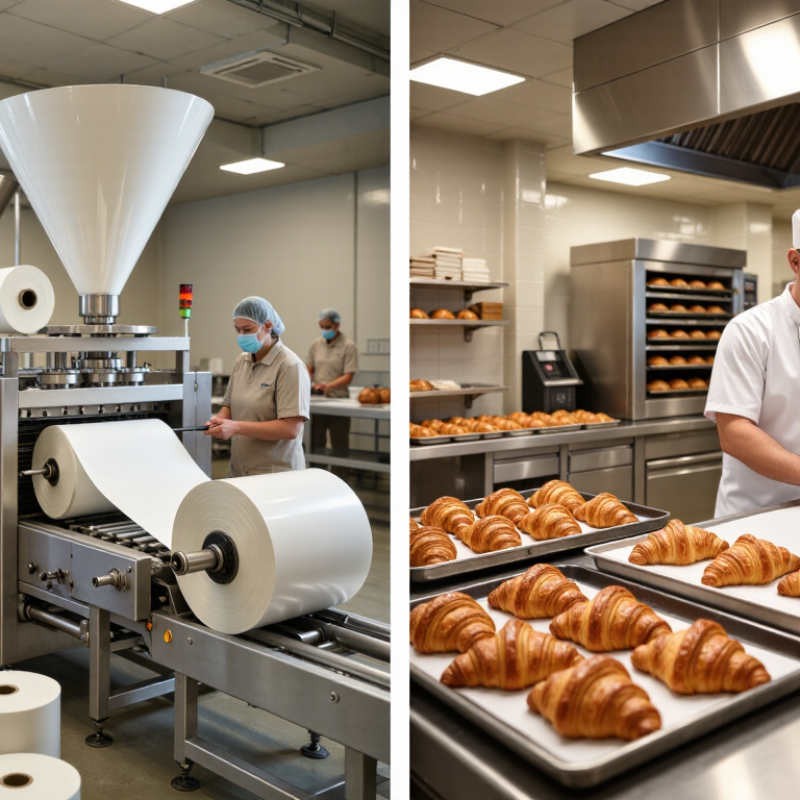
How to Choose the Best Parchment Paper for Global Sourcing?
Parchment paper has several types, and each suits a different sourcing purpose. Vegetable parchment is dense, smooth, and grease-resistant. It works well for bakery wrapping and direct food contact. Silicone-coated parchment releases baked goods easily from trays. Single-sided coating can reduce cost, while double-sided coating supports heavier, stickier products. Bleached sheets offer a clean appearance. Unbleached grades provide a more natural visual identity. Pre-cut sheets suit commercial kitchens, while rolls support automated production lines.
Global sourcing decisions should reflect supply scale and end use. FAO reported approximately 401 million tonnes of global paper and paperboard production in 2022. CEPI recorded about 90.6 million tonnes of European paper and board production in 2023. These figures show a large material base, but not every mill produces food-grade parchment. Ask suppliers for basis weight, silicone coverage, roll width, moisture resistance, and food-contact documentation. Request migration test results when the paper touches food directly. Check packaging strength during humid shipping conditions.
A low unit price can still become expensive. Weak cores may deform inside a container. Poor release performance can increase product waste. I would not trust a sample tested only in dry conditions. Small details matter. Specify carton dimensions, pallet limits, and storage humidity before ordering. Compostable claims also need careful review, because coating chemistry and local facilities affect real disposal outcomes. The right parchment type is not always the thinnest or cheapest option.
Parchment paper looks simple, but food-contact safety begins with the intended application. Ask whether it will touch oily pastries, frozen foods, or acidic sauces. Each use can change the compliance risk. Require a current declaration of compliance and migration-test results for the destination market. Check limits for coating components, inks, adhesives, and optical brighteners. Supplier documents matter. However, documents alone are not proof of consistent production.
Examine the base sheet, coating, and converting process. Virgin fibers, controlled bleaching, and clean silicone application can support safer contact. Request basis weight, thickness, moisture, and heat-resistance specifications.
Hold a sample near a bright window. Uneven translucency may reveal coating variation. Rub the surface gently. Excessive flaking or odor deserves investigation. This is practical, not a laboratory test.
Performance should be tested in the actual oven, not only on a datasheet. Bake greasy cookies, wet dough, and delicate fish portions at the highest planned temperature. Record sticking, tearing, curling, browning, and release after cooling. Ask for batch traceability, retained samples, and independent testing. An audit can show hygiene controls and calibration practices. Still, one successful sample can mislead. Humidity, storage time, and machine tension may expose weaknesses later. Build acceptance criteria before ordering, then review failures openly with the supplier.
Choosing parchment paper for global sourcing requires more than comparing unit prices. Suppliers should be assessed by coating control, paper weight, roll width, and batch consistency. A 2023 CEPI industry report shows that European paper production remains highly dependent on recovered fiber, energy efficiency, and regional mill capacity. This matters because parchment production needs stable base paper and controlled silicone or grease-resistant treatment. Ask each supplier for GSM tolerance, release performance, food-contact documentation, and recent test results.
Manufacturing regions offer different advantages. European mills often provide strong quality systems and traceability. Asian producers may offer flexible minimum order quantities and competitive conversion capacity. North American suppliers can support shorter delivery routes for regional buyers. However, regional reputation is not enough. Review machine age, annual output, coating-line speed, laboratory equipment, and backup power. FAO forestry statistics highlight continuing pressure on fiber resources, so responsible sourcing should include certified fiber claims and mill-level environmental records. I have seen attractive samples fail during high-speed packing. Sample approval is not production approval.
Tips:
Request three production samples, not one. Test heat resistance, tearing, curling, and food release at actual line speed. Compare landed cost, not factory price. Check lead times across two seasons. Ask for a corrective-action report when defects appear. Suppliers may provide polished documents, but factory evidence can be incomplete. Leave room for doubt. A small pilot order often reveals more than a long presentation.
How to Choose the Best Parchment Paper for Global Sourcing?
Choosing parchment paper for global sourcing requires more than comparing price per roll. In supplier audits, I check food-contact certificates, test dates, issuing laboratories, and the exact paper grade. A certificate alone is not proof. The document should match the product, coating, intended temperature, and destination market. Ask whether recycled fibers, silicone, dyes, or release agents are covered. Some suppliers provide impressive files, but outdated reports can create expensive delays.
Packaging affects quality before the paper reaches a kitchen or factory. For ocean shipments, moisture-resistant cartons, sealed inner bags, and corner protection reduce curling and contamination. Request pallet dimensions, roll or sheet counts, carton weights, and clear lot coding. Photographs help, but physical samples reveal more. I compare a sample after warm storage and a rough transport simulation. Still, my testing is not a substitute for an accredited laboratory. That distinction matters. I have learned that small packaging assumptions can become large sourcing problems.
International compliance also includes labels, languages, customs data, and packaging-material rules. Confirm the tariff classification, country-of-origin marking, and declarations required by each importer. Do not assume one market’s approval travels everywhere. Keep a written specification covering basis weight, width tolerance, heat resistance, and migration limits. A small mismatch can stop a shipment. I prefer suppliers who explain limitations instead of promising universal compliance. Before signing, request a retained sample and a change-notification clause. Paper can change quietly.
Verify certifications, packaging options, and international compliance before approving a parchment paper supplier.
The chart compares the number of common verification areas typically reviewed for food-contact parchment paper in major destination markets. Buyers should request food-contact declarations, migration-test evidence, traceability records, packaging specifications, and applicable recycled-content or forestry certification documents.
Reference frameworks include EU Regulation (EC) No. 1935/2004, EU GMP Regulation (EC) No. 2023/2006, FDA 21 CFR 176.170, UK food-contact materials rules, and relevant packaging-waste requirements.
A low unit price can hide expensive decisions. I compare basis weight, roll width, coating consistency, carton strength, and usable yield before approving a parchment paper supplier. A 40-cent roll may create more waste than a 48-cent alternative if edges curl during packing. Measure actual sheets, not only the specification sheet. Small differences matter.
Calculate landed cost per usable sheet. Include paper price, tooling, inspection, inland transport, ocean freight, insurance, duties, warehousing, and rejected units. Add currency movement and port storage exposure. A practical test uses three sample cartons in humid and dry conditions. Check grease resistance, baking release, tearing, odor, and dimensional stability after transit. Logistics risk is physical. It is also administrative. Missing documents can delay a shipment for days.
Supplier value appears over time. Review delivery accuracy, batch records, corrective actions, communication speed, and capacity during peak seasons. Ask for retained samples from several production lots. Audit the process when possible. I have seen suppliers meet laboratory targets but struggle with pallet compression. That gap deserves attention. A spreadsheet can still lie. Forecasts change, and my first cost model is often too optimistic. Build a risk allowance instead of pretending certainty. A reliable supplier should explain limitations clearly, protect traceability, and improve after a failed trial. That behavior may be worth more than the lowest quotation.
All products and services provided by Innovative Plastic Molders, Inc. will meet or exceed our customer's perceived requirements and expectations. We will listen and respond to what our customers are telling us in a timely and forthright manner.

ISO 9001:2015 CERTIFIED
© Copyright 2009 – Innovative Plastic Molders, Inc.
Website by Central 8 Marketing
10451 Dog Leg Road Ste 200
Vandalia, OH 45377
Phone: 937.898.3775
Fax: 937.535.0640
Email: sale@endtheplastic.com

