
Why Choose Welding Tube for Your Project?
Choosing a tube is not just a matter of matching diameter and price. The manufacturing route affects strength, tolerances, weld inspection, and delivery options. A Welding Tube is formed from steel strip or plate, then joined along a seam. That process can support consistent dimensions and efficient production for many structural, mechanical, and fluid-handling applications.
The scale of the steel industry helps explain why availability matters. World Steel Association’s World Steel in Figures 2024 reports that global crude steel production reached about 1.89 billion tonnes in 2023. This figure describes steel overall, not welded tubing alone, but it shows the depth of the material supply base. In practice, buyers still need to confirm grade, wall thickness, outside diameter, and applicable product requirements with their supplier. Details matter.
Welded tube can be a practical choice when the design suits its properties and the supplier can document quality controls. Relevant checks may include seam integrity, dimensional inspection, material traceability, and testing required by the project specification. Standards such as ASTM A500 or ASTM A513 may apply to particular products, but they are not interchangeable. The correct specification depends on the service conditions and design.
There is no universal winner. Seamless tube may be more suitable for some demanding applications, while welded products can offer useful cost and size options. A small oversight in specification can become an expensive delay. So compare the actual requirements, not just the quote.
What Welding Tube Is and How It Is Made
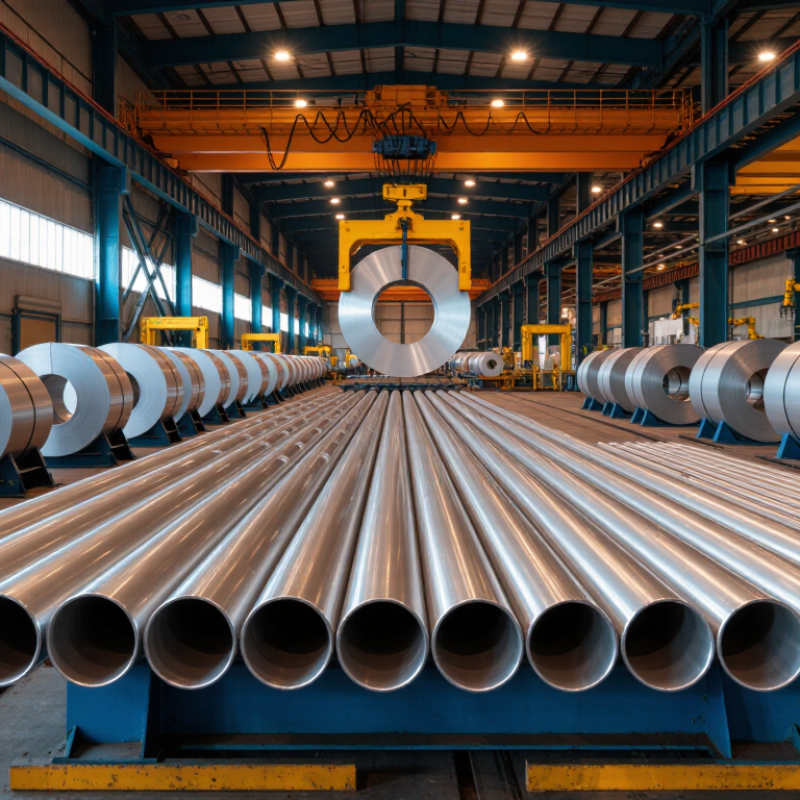
Welded tube is made from flat steel strip, not formed as a solid billet. A coil is slit to the required width, then shaped by rollers until its edges meet. In electric-resistance welding, heat and pressure join those edges into a continuous seam. Filler metal is generally not added. The tube is then cooled, sized, cut to length, and checked for defects. Some lines also apply heat treatment to improve seam consistency.
The World Steel Association’s World Steel in Figures 2025 reports 1,882.6 million tonnes of crude steel production worldwide in 2024. That figure describes steel production, not welded-tube output, but it shows the scale of the material supply behind tube manufacturing. For a project, check more than the outside diameter. Wall thickness, steel grade, seam quality, and the intended load all matter. Standards such as ASTM A500 specify requirements for structural tubing, while other applications may need different specifications. A small mismatch in wall thickness can affect fit and strength. It is an easy detail to overlook. Even a clean-looking seam needs appropriate inspection.
Why Choose Welding Tube for Your Project? — What Welding Tube Is and How It Is Made
| Topic | What It Means | Why It Matters for a Project |
|---|---|---|
| What welded tube is | A tube made by forming flat metal strip or sheet into a round, square, or other profile and joining its edges with a longitudinal weld seam. | It provides a practical option for structural, mechanical, and fluid-handling designs when the required material, dimensions, and applicable specifications are met. |
| Starting material | Production commonly begins with a coil or cut length of steel, stainless steel, or another weldable metal. The exact material grade is selected for the required strength, corrosion resistance, and service conditions. | Choosing the correct grade is essential; tube shape alone does not establish pressure, temperature, or corrosion suitability. |
| Forming process | Rolls progressively bend the flat strip into a tubular profile. The edges are brought together along the length of the tube. | Continuous forming is suited to repeat production and can support consistent dimensions when process controls and inspection requirements are specified. |
| Welding methods | Common methods include electric-resistance welding (ERW), often using high-frequency current, and other processes such as laser or gas-tungsten-arc welding for particular products. | The appropriate method depends on material, wall thickness, tube dimensions, production volume, and the applicable product specification. |
| Seam treatment | Depending on the product, the weld bead may be trimmed or left in place. Some products receive additional heat treatment or finishing after welding. | Seam condition can affect internal clearance, surface finish, fatigue performance, and suitability for subsequent fabrication. |
| Sizing and finishing | After welding, sizing rolls help achieve the specified outside dimensions and profile. Tubes may then be cut to length and supplied with specified end or surface finishes. | Clear dimensional and finish requirements help ensure fit with connectors, fixtures, and assembly equipment. |
| Inspection and testing | Inspection may include dimensional checks, visual examination, and specified nondestructive or pressure testing. Requirements vary by product and standard. | Define the required tests and acceptance criteria in the purchase specification rather than assuming that every welded tube receives the same testing. |
| Potential advantages | Welded tube can be produced in continuous processes and in a broad range of sizes, shapes, materials, and finishes. Availability and cost depend on the product and market. | It can be a suitable choice when the required dimensions and performance are available in a welded product and the project benefits from repeatable production. |
| Important selection checks | Confirm material grade, outside dimensions, wall thickness, tolerances, seam requirements, end finish, testing, and the governing product standard. | For pressure, structural, or corrosive service, verify that the selected tube is specifically permitted for the intended use and operating conditions. |
| Typical applications | Depending on grade and specification, welded tube is used in frames, furniture, automotive components, equipment, heat exchangers, and some fluid-handling systems. | Application suitability must be confirmed against design loads, operating environment, relevant codes, and required certification. |
Note: Manufacturing steps, available sizes, tolerances, and testing requirements vary by material, product type, and governing standard. Confirm the applicable specification for each project.
Our Promise to You

Contact IPM
Phone: 937.898.3775
Fax: 937.535.0640
Email: sale@endtheplastic.com