7 Best Quick Connect Fittings for Global Buyers?
Choosing the right Quick Connect Fitting is rarely about speed alone. Global buyers must consider pressure, temperature, media compatibility, thread standards, sealing methods, and service conditions. A coupling that performs well in a clean factory may fail prematurely in dusty construction equipment or humid marine environments. Small details matter. Material, valve design, locking style, and hose movement can change the entire result.
According to Daniel R. Smith, a senior fluid-power engineer with more than two decades of field experience, “A quick coupling is valuable only when it connects quickly and performs reliably afterward.” This practical view guides our comparison of the 7 Best Quick Connect Fittings for Global Buyers. We examine products through real purchasing concerns, including repeated connection cycles, leakage prevention, corrosion resistance, pressure stability, and replacement availability. Buyers should also verify regional thread standards and supplier documentation before ordering. A familiar-looking thread is not always compatible.
The ranking is not absolute. No fitting wins in every application. That is worth remembering. Some models prioritize compact dimensions, while others provide stronger flow capacity or improved safety locking. A workshop technician may value one-hand operation. A procurement manager may focus on lifecycle cost and international support. We also consider imperfect situations, such as limited technical data, inconsistent labeling, or difficult maintenance access. These issues can create expensive delays after installation. By combining engineering principles, practical observations, and transparent selection criteria, this guide helps global buyers choose a Quick Connect Fitting with greater confidence and fewer surprises.
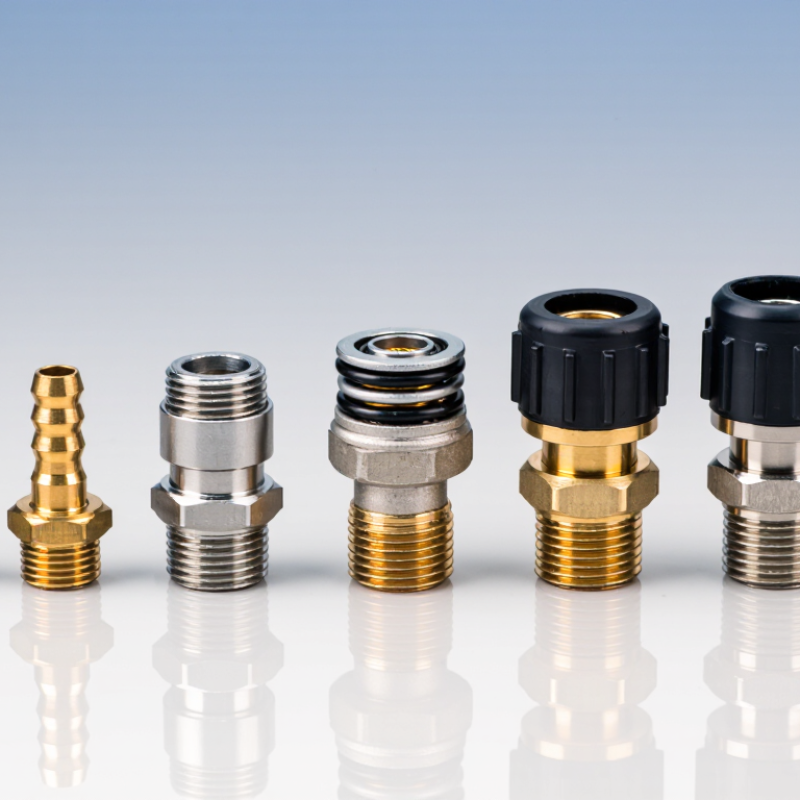
Quick-Connect Fittings Explained: ISO 7241 and 700-Bar Hydraulic Ratings
Global buyers often compare seven quick-connect fitting options, but pressure standards deserve closer attention. ISO 7241 defines dimensional and performance requirements for hydraulic quick couplings. It supports interchangeability within the correct series, not universal compatibility. Series A and Series B may look similar, yet they can connect differently. That detail causes expensive mistakes.
A 700-bar rating means little without test conditions. Check whether the rating applies to static pressure, working pressure, or impulse cycles. Confirm both coupling halves, not only the hose. At this pressure, thread accuracy, locking sleeves, seal materials, and heat resistance matter. A small seal defect can produce a dangerous jet. I have seen buyers focus on maximum pressure while overlooking flow loss. That is a poor trade.
Tips: Request the full datasheet, dimensional drawing, material information, and pressure-test evidence. Match the coupling series before comparing prices. Check the working temperature, hydraulic fluid, and allowable pressure drop. Inspect for trapped pressure before connection. Never assume an ISO 7241 coupling is suitable for 700 bar. The actual rating must be stated clearly. If the application includes frequent connection cycles, review impulse-life data and locking reliability. I would also recheck the fitting after installation; even careful selection can miss a thread or seal mismatch.
How to Rank 7 Designs: Pressure, Flow, Temperature, and Leak Standards
For global buyers, I rank seven quick connect designs by pressure control, flow capacity, temperature range, and leak performance. Ball-lock couplings offer balanced pressure handling and simple maintenance. Flat-face couplings reduce fluid loss during connection. They suit hydraulic lines where cleanliness matters. Push-to-connect fittings install quickly, but their holding strength depends on tubing quality and correct insertion. Screw-to-connect designs resist vibration well. They need more time during service.
Cam-lock couplings provide wide flow passages for water, air, and low-pressure fluids. They are convenient, but accidental opening requires careful handling. Dry-break couplings limit spills during disconnection. Their seals may restrict flow slightly. High-flow couplings support demanding transfer rates, yet their size can increase cost and installation weight. I would verify pressure ratings at the actual operating temperature, not at room temperature. Heat can soften seals and lower safety margins. Check the pressure drop across each fitting at the expected flow rate. A low-pressure test may hide turbulence, poor machining, or an undersized valve.
Leak testing should include connection cycles, vibration, and thermal changes. Look for documented standards, material certificates, and traceable test records. ISO 7241 can help compare hydraulic coupling dimensions, but it does not replace application testing. I have seen fittings pass static tests and seep after repeated connection cycles. That detail is easy to miss. Thread compatibility also deserves attention. Metric and inch threads may appear similar, but they are not interchangeable. A perfect ranking is impossible without the medium, hose size, pressure spikes, and service environment. That limitation should remain visible.
7 Quick-Connect Fitting Designs: A Buyer’s Screening Guide
Illustrative 1–5 screening scores across pressure capability, flow potential, temperature suitability, and leak-control potential. Scores are a comparison framework—not measured product ratings; verify actual limits against manufacturer data and applicable standards.
How to use: Treat these ratings as an initial shortlist, not a specification. Confirm working pressure, flow capacity, temperature range, seal compatibility, and leakage requirements for the exact size, material, and application. ISO 7241 and ISO 16028 cover hydraulic quick-action couplings; applicable requirements depend on the system.
Global Thread Guide: NPT, BSPP, BSPT, and ISO 228 Compatibility
Global buyers often choose quick connect fittings by pressure rating first. Thread compatibility deserves equal attention. A 2024 market report by Grand View Research valued the global fluid connectors market at billions of dollars, with steady growth expected through 2030. That growth reflects wider equipment sourcing, but mixed thread standards still create costly installation errors.
NPT uses a tapered thread under ASME B1.20.1. BSPT also tapers, but its angle and pitch differ. They are not reliable substitutes. BSPP uses parallel threads and commonly follows ISO 228-1. Sealing usually depends on an O-ring, bonded seal, or gasket. ISO 7-1 threads seal through the thread area, while ISO 228 threads do not. I have seen fittings tighten smoothly and still leak. That is the dangerous part.
Tips: Confirm the port standard, thread size, seal method, and pressure rating together. A 1/4-inch NPT fitting is not automatically compatible with a 1/4-inch BSPP port. Check ISO 4414 guidance for pneumatic safety and test the assembled connection at controlled pressure. Keep a thread gauge nearby. Photos can mislead. One practical improvement is simple: record the female port specification before ordering. It takes minutes, yet many purchasing teams skip it. That habit deserves reconsideration.