

China Best AGV Technology Suppliers for Global Buyers?
China has become a major source of automated guided vehicle solutions for global buyers. According to the International Federation of Robotics’ World Robotics 2024 report, China installed 276,288 industrial robots in 2023. This represented more than half of global installations. The figure does not measure AGVs directly, but it shows the depth of China’s automation ecosystem.
Agv Technology now supports warehouse transport, factory replenishment, pallet movement, and cold-chain handling. A typical deployment may involve a 1,000-kilogram vehicle moving between storage racks and production lines. Cameras, laser scanners, magnetic guidance, and fleet software must work together. The vehicle itself is only one part of the project. Battery life, floor conditions, safety zones, navigation accuracy, and service response often decide the real return on investment.
MHI’s 2024 Annual Industry Report also identified automation and digital transformation as continuing priorities for supply-chain leaders. However, market reports often group AGVs, autonomous mobile robots, and related systems together. Comparisons can therefore become misleading. No supplier ranking is perfect. Global buyers should examine tested payload data, integration experience, software compatibility, spare-parts access, and documented safety procedures. Factory visits can reveal more than polished brochures: observe charging areas, aisle congestion, emergency stops, and operator training. This guide evaluates China’s leading Agv Technology suppliers through those practical criteria, while considering certification, export support, customization, and lifecycle service. Prices matter, but downtime usually matters more.
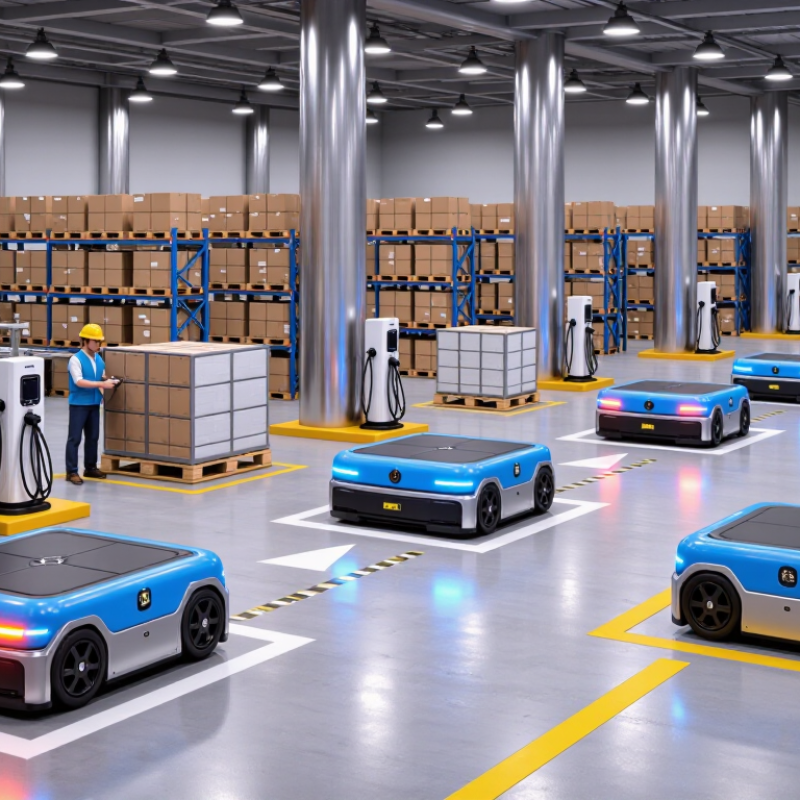
What Is AGV Technology and How Does It Work?
AGV technology enables guided vehicles to move materials without continuous human driving. Unlike ordinary forklifts, AGVs follow programmed routes inside warehouses and factories. They may use magnetic markers, QR codes, laser navigation, or mapped environmental features. The selected method depends on floor conditions, traffic, and delivery accuracy.
The vehicle begins with a transport request from warehouse software. Its controller selects a route and checks nearby obstacles through scanners, cameras, or safety sensors. Motors then adjust speed and direction along the planned path. Small corrections matter. If a person enters the route, the AGV slows or stops. At the destination, it may lift a pallet, connect with a conveyor, or unload beside a workstation. Fleet software coordinates several vehicles, reducing congestion and assigning charging times.
Reliable AGV operation requires more than purchasing equipment. Site surveys should examine aisle width, floor quality, lighting, and pedestrian habits. Teams must also test real loads, not only empty vehicles. That sounds simple. Yet uneven floors can affect navigation, while poorly placed pallets may block a route. Field experience shows that unclear operating rules create avoidable delays. One missed assumption can weaken an otherwise capable system. Regular inspections, route updates, and operator training help maintain stable performance as production conditions change.
China Best AGV Technology Suppliers for Global Buyers? - What Is AGV Technology and How Does It Work?
A technology-focused comparison framework for evaluating AGV solutions without using company or brand data
| AGV Technology / Evaluation Dimension | How It Works | Typical Operating Range or Capability | Best-Fit Applications | Key Buyer Considerations |
|---|---|---|---|---|
| Magnetic Tape Guidance | Magnetic sensors detect a tape or magnetic strip installed on the floor and guide the vehicle along a predefined route. | Usually suitable for fixed routes, with travel speeds commonly around 0.8–1.5 m/s depending on payload and safety settings. | Repetitive pallet, cart, and line-side material movement in stable warehouse or factory layouts. | Low installation complexity and cost, but route changes require physical tape modification and floor maintenance. |
| QR-Code or Floor-Marker Navigation | An onboard camera reads coded floor markers to determine position and trigger route instructions. | Provides repeatable point-to-point movement; accuracy commonly depends on marker spacing, lighting, and camera quality. | Production logistics, work-in-process transport, and structured warehouse routes. | Markers are inexpensive, but dirt, wear, glare, and poor lighting can affect recognition reliability. |
| Laser-Based SLAM | LiDAR scans surrounding structures while software simultaneously builds a map and estimates the vehicle’s position. | Supports flexible routing and dynamic obstacle avoidance; performance depends on map quality, LiDAR specification, and site conditions. | Mixed-traffic warehouses, distribution centers, and facilities where routes change frequently. | Higher software and integration requirements, but minimal physical infrastructure and better layout flexibility. |
| Reflector-Based Laser Navigation | A laser scanner measures distances to reflective targets installed around the facility to calculate position. | Offers repeatable positioning in mapped industrial environments when reflective targets remain visible and correctly installed. | Large factories, high-bay warehouses, and applications requiring stable localization. | Reliable in structured spaces, but installation planning and line-of-sight management are essential. |
| Natural-Feature Navigation | Cameras, LiDAR, or other sensors recognize existing walls, racks, columns, and landmarks without dedicated floor guides. | Suitable for flexible environments, provided the facility has sufficient stable visual or geometric features. | Facilities requiring rapid deployment, frequent reconfiguration, or minimal infrastructure changes. | Lighting, occlusion, reflective surfaces, and major layout changes must be assessed during site validation. |
| Payload Capacity | The maximum rated load the AGV can transport safely, including the carrier, pallet, rack, or handling fixture. | Common industrial categories range from approximately 100 kg to more than 5,000 kg; exact limits are model-specific. | Tugging, pallet transport, production-line feeding, and heavy-load warehouse operations. | Select capacity with a safety margin for uneven loads, acceleration, ramps, turning, and attachment weight. |
| Navigation Accuracy | Sensors and control software continuously estimate position and correct steering or motion to follow the planned path. | Typical system-level positioning may range from several millimeters to several centimeters, depending on technology and environment. | Rack approach, conveyor transfer, robotic handoff, and automated charging alignment. | Request measured accuracy under real operating conditions rather than relying only on laboratory specifications. |
| Obstacle Detection and Safety | Safety scanners, bumpers, emergency stops, speed control, and warning systems detect people or objects and reduce or stop motion. | Protective fields and stopping distances must be configured according to vehicle speed, payload, braking performance, and site risk assessment. | Shared human-machine workspaces, warehouses, factories, and logistics transfer areas. | Verify compliance with applicable machinery, electrical, and industrial mobile-robot safety requirements in the target market. |
| Fleet Management | A central software system assigns missions, controls traffic, manages priorities, monitors status, and coordinates charging. | Scalability varies by software architecture, network design, traffic rules, and the number of vehicles deployed. | Multi-vehicle warehouses, production networks, and facilities with several pickup and delivery points. | Evaluate dispatch logic, traffic deadlock handling, reporting, user permissions, cybersecurity, and API availability. |
| System Integration | The AGV exchanges missions and status information with warehouse, manufacturing, enterprise, conveyor, or robotic systems. | Common interfaces include REST APIs, industrial Ethernet, digital I/O, message brokers, and standardized fleet-management concepts. | Automated storage, conveyor lines, picking systems, assembly operations, and enterprise logistics workflows. | Confirm protocol documentation, data ownership, interface testing, remote support, and commissioning responsibilities. |
| Battery and Charging | The vehicle uses rechargeable batteries and may support manual, opportunity, automatic, or battery-swap charging. | Runtime commonly varies from several hours to a full shift, depending on payload, duty cycle, battery chemistry, and charging strategy. | Continuous production and warehouse operations requiring high vehicle availability. | Compare charging time, battery life, thermal management, replacement cost, energy consumption, and maintenance access. |
| Global Deployment Readiness | The solution is prepared for international installation through documentation, training, remote diagnostics, spare parts, and local service processes. | Readiness depends on target-country regulations, electrical requirements, language support, shipping arrangements, and service coverage. | Cross-border procurement, multinational manufacturing, and international warehouse projects. | Request compliance documents, acceptance criteria, warranty terms, spare-parts lead times, training plans, and escalation contacts. |
Our Promise to You

Contact IPM
Phone: 937.898.3775
Fax: 937.535.0640
Email: sale@endtheplastic.com